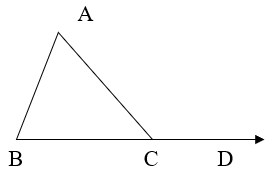
1. In Fig. 3.8, \(\angle\)ACD is an exterior angle of \(\triangle\)ABC. \(\angle\)B = 40°, \(\angle\)A = 70°. Find the measure of \(\angle\)ACD
Solution:
In \(\triangle\)ABC,
∴ \(\angle\)ACD = \(\angle\)A + \(\angle\)B
... (Remote interior angles theorem)
∴ \(\angle\)ACD = 70° + 40° ... (Given)
∴ \(\angle\)ACD = 110°
2. In \(\triangle\)PQR, \(\angle\)P = 70°, \(\angle\)Q = 65°, then find \(\angle\)R.
Solution:
In \(\triangle\)PQR,
\(\angle\)P + \(\angle\)Q + \(\angle\)R = 180° ... (Theorem)
∴ 70° + 65° + \(\angle\)R = 180° ... (Given)
∴ 135° + \(\angle\)R = 180°
∴ \(\angle\)R = 180° − 135°
∴ \(\angle\)R = 45°
3. The measures of angles of a triangle are x°, (x − 20)° and (x − 40)°. Find the measure of each angle.
Solution:
The sum of the measures of all angles of a triangle is 180°. ... (Theorem)
∴ x + (x − 20) + (x − 40) = 180
∴ x + x − 20 + x − 40 = 180
∴ 3x − 60 = 180
∴ 3x = 180 + 60
∴ 3x = 240
∴ x = \(\displaystyle \frac{240}{3}\)
∴ x = 80 ... (i)
∴ x − 20 = 80 − 20 = 60° ... (ii)
and x − 40 = 80 − 40 = 40° ... (iii)
∴ The angles of that triangle are 80°, 60° and 40°.
4. The measure of one of the angles of a triangle is twice the measure of its smallest angle and the measure of the other is thrice the measure of the smallest angle. Find the measures of the three angles.
Solution:
Let the smallest angle be x°.
Then, the measures of the other two angles are 2x° and 3x°.
The sum of the measures of all angles of a triangle is 180°. ... (Theorem)
∴ x + 2x + 3x = 180
∴ 6x = 180
∴ x = \(\displaystyle \frac{180}{6}\)
∴ x = 30° ... (i)
∴ 2x = 2 × 30 = 60° ... (ii)
and 3x = 3 × 30 = 90° ... (iii)
∴ The the measures of the angles of that triangle are 30°, 60° and 90°.
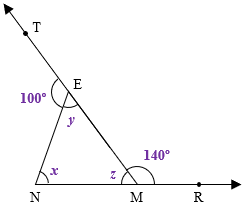
5. In figure 3.9, measures of some angles are given. Using the measures, find the values of x, y, z.
Solution:
\(\angle\)EMN + \(\angle\)EMR = 180°
... (Angles in Linear Pair)
∴ z + 140° = 180°
∴ z = 180° − 140°
∴ z = 40° ... (i)
Also, \(\angle\)NEM + \(\angle\)NET = 180°
... (Angles in Linear Pair)
∴ y + 100° = 180°
∴ y = 180° − 100°
∴ y = 80° ... (ii)
And \(\angle\)ENM + \(\angle\)NEM = \(\angle\)EMR
... (Remote interior angles theorem)
∴ x + 80° = 140°
∴ x = 140° − 80°
∴ x = 60° ... (iii)
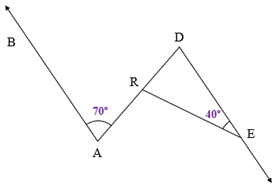
6. In figure 3.10, line AB | | line DE. Find the measures of \(\angle\)DRE and \(\angle\)ARE using given measures of some angles.
Solution:
line AB | | line DE ... (Given)
Consider transversal AD.
\(\angle\)ADE \(\cong\) \(\angle\)DAB ... (Alternate angles)
But, \(\angle\)DAB = 70° ... (Given)
∴ \(\angle\)ADE = 70°
i.e. \(\angle\)RDE = 70° ... (i)
Now, in \(\triangle\)RDE,
\(\angle\)DRE + \(\angle\)RED + \(\angle\)RDE = 180° ... (Theorem)
∴ \(\angle\)DRE + 40° + 70° = 180° ... [From (i) and Given]
∴ \(\angle\)DRE + 110° = 180°
∴ \(\angle\)DRE = 180° − 110°
∴ \(\angle\)DRE = 70° ... (ii)
Finally,
\(\angle\)ARE + \(\angle\)DRE = 180° ... (Angles in Linear Pair)
∴ \(\angle\)ARE + 70° = 180° ... [From (ii)]
∴ \(\angle\)ARE = 180° − 70°
∴ \(\angle\)ARE = 110° ... (iii)
7. In \(\triangle\)ABC, bisectors of \(\angle\)A and \(\angle\)B intersect at point O. If \(\angle\)C = 70°. Find the measure of \(\angle\)AOB.
Solution:
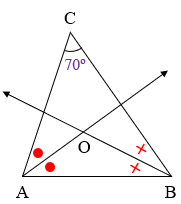
Ray AO is the bisector of \(\angle\)CAB. ... (Given)
∴ \(\angle\)CAO = \(\angle\)BAO = x (say)
∴ \(\angle\)CAB = \(\angle\)CAO + \(\angle\)BAO ... (Angle Addition Postulate)
∴ \(\angle\)CAB = x + x
∴ \(\angle\)CAB = 2x ... (i)
Also, ray BO is the bisector of \(\angle\)CBA. ... (Given)
∴ \(\angle\)CBO = \(\angle\)ABO = y (say)
∴ \(\angle\)CBA = \(\angle\)CBO + \(\angle\)ABO ... (Angle Addition Postulate)
∴ \(\angle\)CBA = y + y
∴ \(\angle\)CBA = 2y ... (ii)
Now, in \(\triangle\)ABC,
\(\angle\)CAB + \(\angle\)CBA + \(\angle\)ACB = 180° ... (Theorem)
∴ 2x + 2y + 70° = 180° ... [From (i), (ii) and (Given)]
∴ 2(x + y) + 70° = 180°
∴ 2(x + y) = 180° - 70°
∴ 2(x + y) = 110°
∴ x + y = \(\displaystyle \frac{110}{2}\)
∴ x + y = 55° ... (iii)
Finally, in \(\triangle\)AOB,
\(\angle\)AOB + \(\angle\)BAO + \(\angle\)ABO = 180° ... (Theorem)
∴ \(\angle\)AOB + x + y = 180°
∴ \(\angle\)AOB + 55° = 180° ... [From (iii)]
∴ \(\angle\)AOB = 180° − 55°
∴ \(\angle\)AOB = 125°
8. In figure 3.11, line AB | | line CD and line PQ is the transversal. Ray PT and ray QT are the bisectors of \(\angle\)BPQ and \(\angle\)PQD respectively. Prove that m\(\angle\)PTQ = 90°.
Proof:
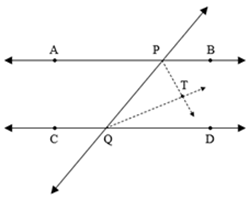
Ray PT is the bisector of \(\angle\)BPQ. ... (Given)
∴ \(\angle\)BPT = \(\angle\)QPT = x (say)
∴ \(\angle\)BPQ = \(\angle\)BPT + \(\angle\)QPT ... (Angle Addition Postulate)
∴ \(\angle\)BPQ = x + x
∴ \(\angle\)BPQ = 2x ... (i)
Also, ray QT is the bisector of \(\angle\)PQD. ... (Given)
∴ \(\angle\)PQT = \(\angle\)DQT = y (say)
∴ \(\angle\)PQD = \(\angle\)PQT + \(\angle\)DQT ... (Angle Addition Postulate)
∴ \(\angle\)PQD = y + y
∴ \(\angle\)PQD = 2y ... (ii)
And line AB | | line CD ... (Given)
Consider transversal PQ.
∴ \(\angle\)BPQ + \(\angle\)PQD = 180° ... (Interior Angles)
∴ 2x + 2y = 180° ... [From (i) and (ii)]
∴ 2(x + y) = 180°
∴ x + y = \(\displaystyle \frac{180}{2}\)
∴ x + y = 90° ... (iii)
Finally, in \(\triangle\)PTQ,
\(\angle\)PTQ + \(\angle\)QPT + \(\angle\)PQT = 180° ... (Theorem)
∴ \(\angle\)PTQ + x + y = 180°
∴ \(\angle\)PTQ + 90° = 180° ... [From (iii)]
∴ \(\angle\)PTQ = 180° − 90°
∴ \(\angle\)PTQ = 90°
i.e. m\(\angle\)PTQ = 90° ... (Proved)
9. Using the information in figure 3.12, find the measures of \(\angle\)a, \(\angle\)b and \(\angle\)c.
Solution:
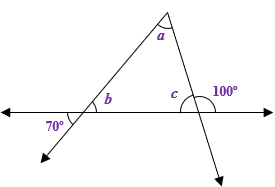
Here, \(\angle\)b = 70° ... (Vertically opposite angles) ... (i)
Also, \(\angle\)c + 100° = 180° ... (Angles in linear pair)
∴ \(\angle\)c = 180° − 100°
∴ \(\angle\)c = 80° ... (ii)
And, in the given triangle,
\(\angle\)a + \(\angle\)b + \(\angle\)c = 180° ... (Theorem)
∴ \(\angle\)a + 70° + 80° = 180° ... [From (i) and (ii)]
∴ \(\angle\)a + 150° = 180°
∴ \(\angle\)a = 180° − 150°
∴ \(\angle\)a = 30° ... (iii)
Therefore, \(\angle\)a = 30°, \(\angle\)b = 70° and \(\angle\)c = 80°
10. In figure 3.13, line DE | | line GF. Ray EG and FG are the bisectors of \(\angle\)DEF and \(\angle\)DFM respectively.
Prove that:
(i) \(\angle\)DEG = \(\displaystyle \frac{1}{2}\) \(\angle\)EDF
(ii) EF = FG
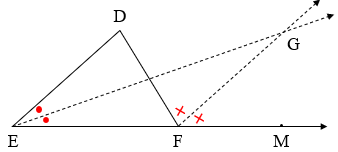
Proof:
(i) Ray EG is the bisector of \(\angle\)DEF. ... (Given)
∴ \(\angle\)DEG = \(\angle\)GEF = x ... (say) ... (i)
Now, \(\angle\)DEF = \(\angle\)DEG + \(\angle\)GEF ... (Angle Addition Postulate)
∴ \(\angle\)DEF = x + x
∴ \(\angle\)DEF = 2x ... (ii)
Also, line DE | | line GF. ... (Given)
Consider transversal EF.
∴ \(\angle\)GFM \(\cong\) \(\angle\)DEF ... (Corresponding angles)
But, \(\angle\)DEF = 2x ... [From (ii)]
∴ \(\angle\)GFM = 2x ... (iii)
Similarly, ray FG is the bisector of \(\angle\)DFM. ... (Given)
∴ \(\angle\)DFG = \(\angle\)GFM
∴ \(\angle\)GFM = 2x ... [From (iii)]
∴ \(\angle\)DFG = 2x ... (iv)
Also, \(\angle\)DFM = \(\angle\)DFG + \(\angle\)GFM ... (Angle Addition Postulate)
∴ \(\angle\)DFM = 2x + 2x ... [From (iii) and (iv)]
∴ \(\angle\)DFM = 4x ... (v)
Now, \(\angle\)DFM is an exterior angle of \(\triangle\)DEF.
∴ \(\angle\)DFM = \(\angle\)EDF + \(\angle\)DEF ... (Remote Interior Angle Theorem)
∴ 4x = \(\angle\)EDF + 2x ... [From (v) and (ii)]
∴ 4x − 2x = \(\angle\)EDF
∴ 2x = \(\angle\)EDF
i.e. 2\(\angle\)DEG = \(\angle\)EDF ... [From (i)]
∴ \(\angle\)DEG = \(\displaystyle \frac{1}{2}\) \(\angle\)EDF ... (vi) ... (Proved)
(ii) Also, line DE | | line GF. ... (Given)
Consider transversal EG.
∴ \(\angle\)DEG \(\cong\) \(\angle\)FGE ... (Alternate angles)
But, \(\angle\)DEG = x ... [From (i)]
∴ \(\angle\)FGE = x ... (vii)
Finally, in \(\triangle\)FEG, we have:
\(\angle\)FGE \(\cong\) \(\angle\)GEF ... [From (vii) and (i)]
∴ \(\triangle\)FEG is an isosceles triangle.
∴ EF = FG ... (viii) ... (Proved)
This page was last modified on
03 April 2026 at 09:57