1. In each of the examples given below, a pair of triangles is shown. Equal parts of triangles in each pair are marked with the same signs. Observe the figures and state the test by which the triangles in each pair are congruent.
(i)
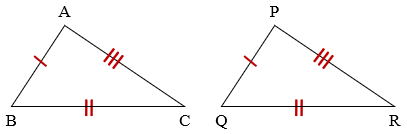
By S S S Test
\(\triangle\)ABC \(\cong\) \(\triangle\)PQR
1. In each of the examples given below, a pair of triangles is shown. Equal parts of triangles in each pair are marked with the same signs. Observe the figures and state the test by which the triangles in each pair are congruent.
(ii)
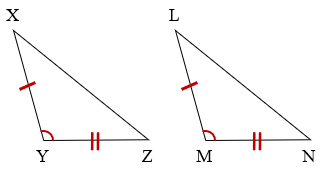
By S A S Test
\(\triangle\)XYZ \(\cong\) \(\triangle\)LMN
1. In each of the examples given below, a pair of triangles is shown. Equal parts of triangles in each pair are marked with the same signs. Observe the figures and state the test by which the triangles in each pair are congruent.
(iii)
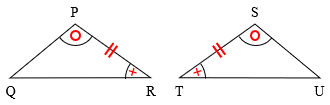
By A S A Test
\(\triangle\)PRQ \(\cong\) \(\triangle\)STU
1. In each of the examples given below, a pair of triangles is shown. Equal parts of triangles in each pair are marked with the same signs. Observe the figures and state the test by which the triangles in each pair are congruent.
(iv)
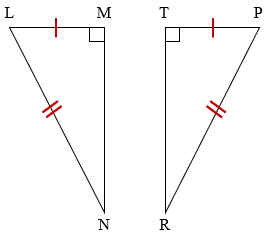
By Hypotenuse-Side Test
\(\triangle\)LMN \(\cong\) \(\triangle\)PTR
2. Observe the information shown in pairs of triangles given below. State the test by which the two triangles are congruent. Write the remaining congruent parts of the triangles.
(i)
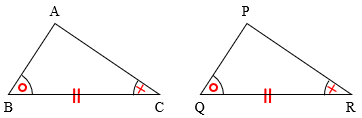
Solution:
From the information shown in the figure,
in \(\triangle\)ABC and \(\triangle\)PQR,
\(\angle\)ABC \(\cong\) \(\angle\)PQR
seg BC \(\cong\) seg QR
\(\angle\)ACB \(\cong\) \(\angle\)PRQ
∴ \(\triangle\)ABC \(\cong\) \(\triangle\)PQR ... A S A Test
∴ \(\angle\)BAC \(\cong\) \(\angle\)QPR ... (c a c t)
seg AB \(\cong\) seg PQ ... (c s c t)
and seg AC \(\cong\) seg PR ... (c s c t)
2. Observe the information shown in pairs of triangles given below. State the test by which the two triangles are congruent. Write the remaining congruent parts of the triangles.
(ii)
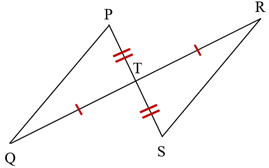
Solution:
From the information shown in the figure,
in \(\triangle\)PTQ and \(\triangle\)STR,
seg PT \(\cong\) seg ST ... (Given)
\(\angle\)PTQ \(\cong\) \(\angle\)STR ... (Vertically Opposite Angles)
seg TQ \(\cong\) seg TR ... (Given)
∴ \(\triangle\)PTQ \(\cong\) \(\triangle\)STR ... S A S Test
∴ \(\angle\)TPQ \(\cong\) \(\angle\)TSR ... (c a c t)
and \(\angle\)TQP \(\cong\) \(\angle\)TRS ... (c a c t)
seg PQ \(\cong\) seg SR ... (c s c t)
3. From the information shown in the figure, state the test assuring the congruence of \(\triangle\)ABC and \(\triangle\)PQR. Write the remaining congruent parts of the triangles.
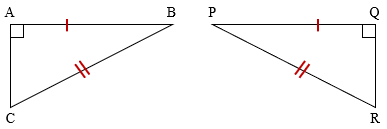
Solution:
\(\triangle\)ABC \(\cong\) \(\triangle\)QPR ... (Hypotenuse-Side Test)
The remaining congruent parts are:
side AC \(\cong\) side QR ... (c s c t)
\(\angle\)ABC \(\cong\) \(\angle\)QPR ... (c a c t)
\(\angle\)ACB \(\cong\) \(\angle\)QRP ... (c a c t)
4. As shown in the following figure, in \(\triangle\)LMN and \(\triangle\)PNM, LM = PN, LN = PM. Write the test which assures the congruence of the two triangles. Write their remaining congruent parts.
Solution:
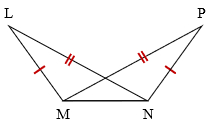
\(\triangle\)LMN \(\cong\) \(\triangle\)PNM ... (S S S Test)
The remaining congruent parts are:
\(\angle\)LMN \(\cong\) \(\angle\)PNM ... (c a c t)
\(\angle\)LNM \(\cong\) \(\angle\)PMN ... (c a c t)
\(\angle\)MLN \(\cong\) \(\angle\)NPM ... (c a c t)
5. In figure 3.24, seg AB \(\cong\) seg CB and seg AD \(\cong\) seg CD. Prove that \(\triangle\)ABD \(\cong\) \(\triangle\)CBD.
Proof:
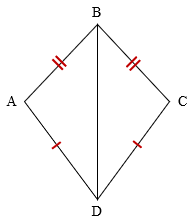
In \(\triangle\)ABD and \(\triangle\)CBD,
seg AB \(\cong\) seg CB ... (Given)
seg AD \(\cong\) seg CD ... (Given)
seg BD \(\cong\) seg BD ... (Common Side)
∴ \(\triangle\)ABD \(\cong\) \(\triangle\)CBD ... (S S S Test)
6. In figure 3.25, \(\angle\)P \(\cong\) \(\angle\)R and seg PQ \(\cong\) seg RQ. Prove that \(\triangle\)PQT \(\cong\) \(\triangle\)RQS.
Proof:
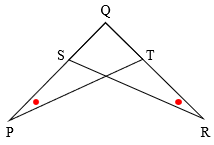
In \(\triangle\)PQT and \(\triangle\)RQS,
\(\angle\)PQT \(\cong\) \(\angle\)RQS ... (Common Angle)
seg PQ \(\cong\) seg RQ ... (Given)
\(\angle\)QPT \(\cong\) \(\angle\)QRS ... (Given)
∴ \(\triangle\)PQT \(\cong\) \(\triangle\)RQS ... (A S A Test)
This page was last modified on
02 April 2026 at 09:00