1. Find the values of x and y using the information shown in figure 3.37. Find the measures of \(\angle\)ABD and \(\angle\)ACD.
Solution:
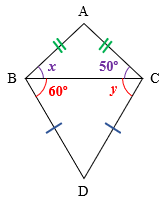
In \(\triangle\)ABC,
seg AB \(\cong\) seg AC ... (Given)
∴ \(\angle\)ABC = \(\angle\)ACB ... (Theorem of Isosceles Triangle)
But, \(\angle\)ACB = 50° ... (Given)
∴ \(\angle\)ABC = 50°
i.e. x = 50° ... (i)
Now, \(\angle\)ABD = \(\angle\)ABC + \(\angle\)DBC ... (Angle Addition Property)
∴ \(\angle\)ABD = 50° + 60°
∴ \(\angle\)ABD = 110° ... (ii)
Also, in \(\triangle\)DBC,
seg BD \(\cong\) seg CD ... (Given)
∴ \(\angle\)DBC = \(\angle\)DCB ... (Theorem of Isosceles Triangle)
But, \(\angle\)DBC = 60° ... (Given)
∴ \(\angle\)DCB = 60°
i.e. y = 60° ... (iii)
And, \(\angle\)ACD = \(\angle\)ACB + \(\angle\)DCB ... (Angle Addition Property)
∴ \(\angle\)ACD = 50° + 60°
∴ \(\angle\)ACD = 110° ... (iv)
2. The length of the hypotenuse of a right angled triangle is 15. Find the length of the median of its drawn on the hypotenuse.
Solution:
In a right angled triangle, the length of the median of the hypotenuse is half the length of the hypotenuse. ... (Theorem)
∴ Length of the median on the hypotenuse = \(\displaystyle \frac{1}{2}\) × Length of the hypotenuse
∴ Length of the median on the hypotenuse = \(\displaystyle \frac{1}{2}\) × 15
∴ Length of the median on the hypotenuse = 7.5
3. In \(\triangle\)PQR, \(\angle\)Q = 90°, PQ = 12, QR = 5 and QS is a median. Find l(QS).
Solution:
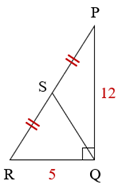
In right \(\triangle\)PQR,
PR² = PQ² + QR² ... (Pythagorean Theorem)
∴ PR² = 12² + 5²
∴ PR² = 144 + 25
∴ PR² = 169
∴ PR = \(\sqrt{169}\)
∴ PR = 13 units ... (i)
Now, in a right angled triangle, the length of the median of the hypotenuse is half the length of the hypotenuse. ... (Theorem)
∴ QS = \(\displaystyle \frac{1}{2}\) × PR
∴ QS = \(\displaystyle \frac{1}{2}\) × 13
∴ QS = 6.5 units ... (ii)
∴ l(QS) = 6.5 units
4. In figure 3.38, point G is the point of concurrence of the medians of \(\triangle\)PQR. If GT = 2.5, find the lengths of PG and PT.
Solution:
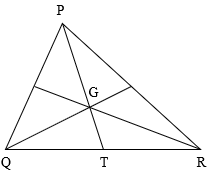
GT = 2.5 ... (Given)
Now, PG ∶ GT = 2 ∶ 1 ... (Property of Centroid)
∴ \(\displaystyle \frac{\text{PG}}{\text{GT}} = \frac{2}{1}\)
∴ \(\displaystyle \frac{\text{PG}}{2.5} = \frac{2}{1}\)
∴ PG = 2 × 2.5
∴ PG = 5 units ... (i)
Also, P – G – T ... (Collinear points)
∴ PT = PG + GT
∴ PT = 5 + 2.5
∴ PT = 7.5 units ... (ii)
∴ PG = 5 units and PT = 7.5 units
This page was last modified on
28 March 2026 at 19:38