1. In Fig. 3.48, point A is on the bisector of \(\angle\)XYZ. If AX = 2 cm, then find AZ.
Solution:
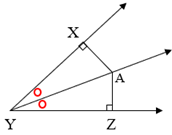
Point A lies on the bisector of \(\angle\)XYZ. ... (Given)
Every point on the bisector of an angle is equidistant from the sides of the angle. ... (Theorem)
∴ AZ = AX
But, AX = 2 cm ... (Given)
∴ AZ = 2 cm
2. In figure 3.49, \(\angle\)RST = 56°, seg PT \(\perp\) ray ST, seg PR \(\perp\) ray SR and seg PR \(\cong\) seg PT. Find the measure of \(\angle\)RSP.
State the
reason for your answer.
Solution:
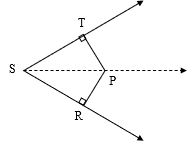
seg PT \(\perp\) ray ST ... (Given)
seg PR \(\perp\) ray SR ... (Given) and
seg PR \(\cong\) seg PT ... (Given)
∴ Point P is equidistant from the sides of \(\angle\)RST.
Any point equidistant from the sides of an angle, lies on the bisector of the angle. ... (Theorem of angle bisector)
∴ Ray SP is the bisector of \(\angle\)RST.
∴ \(\angle\)RSP = \(\displaystyle \frac{1}{2}\) \(\angle\)RST
∴ \(\angle\)RSP = \(\displaystyle \frac{1}{2}\) × 56° ... (Given)
∴ \(\angle\)RSP = 28°
3. In \(\triangle\)PQR, PQ = 10 cm, QR = 12 cm, PR = 8 cm. Find the greatest and the smallest angle of \(\triangle\)PQR.
Solution:
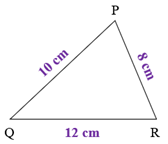
If two sides of a triangle are unequal, then the angle opposite to the greater side is greater than angle opposite to the smaller side. ... (Theorem)
Now, 12 > 10 > 8
∴ QR > PQ > PR
∴ \(\angle\)P > \(\angle\)R > \(\angle\)Q
∴ \(\angle\)P is the greatest angle and \(\angle\)Q is the smallest angle of \(\triangle\)PQR.
4. In \(\triangle\)FAN, \(\angle\)F = 80°, \(\angle\)A = 40°. Find out the greatest and the smallest side of the triangle. State the reason.
Solution:
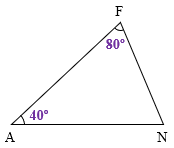
In \(\triangle\)FAN,
\(\angle\)F + \(\angle\)A + \(\angle\)N = 180° ... (Theorem)
∴ 80° + 40° + \(\angle\)N = 180°
∴ 120° + \(\angle\)N = 180°
∴ \(\angle\)N = 180° - 120°
∴ \(\angle\)N = 60°
Now, 80° > 60° > 40°
∴ \(\angle\)F > \(\angle\)N > \(\angle\)A
∴ Side AN > Side FA > Side FN
∴ Side AN is the greatest side and side FN is the smallest side of \(\triangle\)FAN.
5. Prove that an equilateral triangle is equiangular.
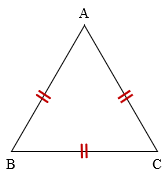
Given:
\(\triangle\)ABC is an equilateral triangle.
i.e. AB = BC = CA
To Prove:
\(\angle\)A \(\cong\) \(\angle\)B \(\cong\) \(\angle\)C
i.e. \(\triangle\)ABC is equiangular triangle.
Proof:
In \(\triangle\)ABC,
BC = CA ... (Given)
∴ \(\angle\)A \(\cong\) \(\angle\)B ... (Theorem of Isosceles Triangle) ... (i)
Also, CA = AB ... (Given)
∴ \(\angle\)B \(\cong\) \(\angle\)C ... (Theorem of Isosceles Triangle) ... (ii)
From (i) and (ii), we have:
\(\angle\)A \(\cong\) \(\angle\)B \(\cong\) \(\angle\)C ... (Transitivity)
∴ \(\triangle\)ABC is equiangular triangle.
∴ An equilateral triangle is equiangular.
6. Prove that, if the bisector of \(\angle\)BAC of \(\triangle\)ABC is perpendicular to side BC, then \(\triangle\)ABC is an isosceles triangle.
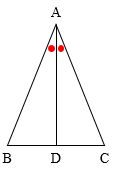
Given:
In \(\triangle\)ABC, seg AD is the bisector of \(\angle\)BAC and seg AD \(\perp\) side BC.
To Prove:
seg AB \(\cong\) seg AC
i.e. \(\triangle\)ABC is an isosceles triangle.
Proof:
In \(\triangle\)ADB and \(\triangle\)ADC,
\(\angle\)ADB \(\cong\) \(\angle\)ADC ... (90° each) ... (Given)
seg AD \(\cong\) seg AD ... (Reflexivity)
\(\angle\)BAD \(\cong\) \(\angle\)CAD ... (Given)
∴ \(\triangle\)ADB \(\cong\) \(\triangle\)ADC ... (A S A test)
∴ seg AB \(\cong\) seg AC ... (c s c t)
i.e. \(\triangle\)ABC is an isosceles triangle.
7. In figure 3.50, if seg PR \(\cong\) seg PQ, show that seg PS > seg PQ.
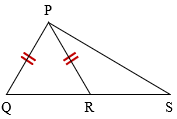
Proof:
In \(\triangle\)PQR,
side PQ \(\cong\) side PR ... (Given)
∴ \(\angle\)Q \(\cong\) \(\angle\)PRQ ... (Theorem of Isosceles Triangle) ... (i)
Now, \(\angle\)PRQ is an exterior angle of \(\triangle\)PRS.
∴ \(\angle\)PRQ > \(\angle\)S ... (Theorem of exterior angle of a triangle) ... (ii)
From (i) and (ii), we have:
\(\angle\)Q > \(\angle\)S ... (iii)
∴ In \(\triangle\)PSQ,
∴ seg PS > seg PQ ... (Theorem)
8. In figure 3.51, in \(\triangle\)ABC, seg AD and seg BE are altitudes and AE = BD. Prove that seg AD \(\cong\) seg BE.
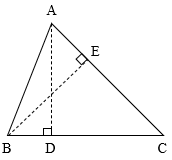
Proof:
In \(\triangle\)ADB and \(\triangle\)BEA,
\(\angle\)ADB \(\cong\) \(\angle\)BEA ... (90° each) ... (Given)
seg AB \(\cong\) seg BA ... (Reflexivity)
seg BD \(\cong\) seg AE ... (Given)
∴ \(\triangle\)ADB \(\cong\) \(\triangle\)BEA ... (Hypotenuse Side Theorem)
∴ seg AD \(\cong\) seg BE ... (c s c t)
This page was last modified on
28 March 2026 at 13:22