1. In figure 5.22, \(\Box\)ABCD is a parallelogram. P and Q are midpoints of side AB and DC respectively. Prove that \(\Box\)APCQ is a parallelogram.
Solution:
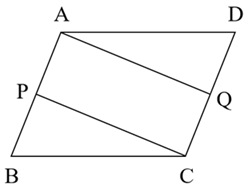
\(\Box\)ABCD is a parallelogram. ... (Given)
∴ AB | | CD ... (Opposite sides of a
parallelogram)
∴ AP | | CQ
... (∵
A – P – B and C – Q – D) ... (i)
Also, AB = CD ... (Opposite sides of a parallelogram)
∴ \(\displaystyle \frac{1}{2}\)AB = \(\displaystyle \frac{1}{2}\)CD
∴ AP = CQ
... (∵ P and Q are midpoints of AB and CD
respectively) ... (ii)
A quadrilateral is a parallelogram if a pair of its opposite sides is parallel and congruent. ... (Theorem)
∴ From (i) and (ii):
∴ \(\Box\)APCQ is a parallelogram.
2. Using opposite angles test for parallelogram, prove that every rectangle is a parallelogram.
Solution:
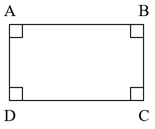
Given:
\(\Box\)ABCD is a rectangle.
To Prove:
\(\Box\)ABCD is a parallelogram.
Proof:
\(\Box\)ABCD is a rectangle. ... (Given)
∴ \(\angle\)A = \(\angle\)B = \(\angle\)C = \(\angle\)D = 90°
... (Angles
of a rectangle)
∴ \(\angle\)A \(\cong\) \(\angle\)C and \(\angle\)B \(\cong\) \(\angle\)D
A quadrilateral is a parallelogram if its pairs of opposite angles are congruent.
∴ \(\Box\)ABCD is a parallelogram.
3. In figure 5.23, G is the point of concurrence of medians of \(\triangle\)DEF. Take point H on ray DG such that D – G – H and DG = GH, then prove that \(\Box\)GEHF is a parallelogram.
Proof:
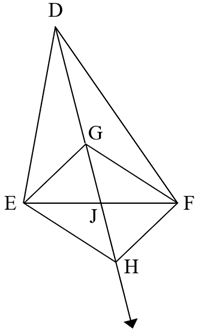
Take point J as shown.
Now, DJ is a median and G is the centroid in \(\triangle\)DEF.
The centroid of a triangle divides the
medians in the ratio 2 ∶ 1. ... (Theorem)
∴ DG = 2GJ
But, DG = GH ... (Given)
∴ GH = 2GJ
∴ J is the midpoint of diagonal
GH. ... (i)
Also, DJ is a median in \(\triangle\)DEF.
∴ J is the midpoint of diagonal EF. ... (ii)
A quadrilateral is a parallelogram if its diagonals bisect each other. ... (Theorem)
From (i) and
(ii),
\(\Box\)GEHF is a parallelogram.
4. Prove that the bisectors of the four angles of a parallelogram, which is not a rhombus form a rectangle.
Solution:
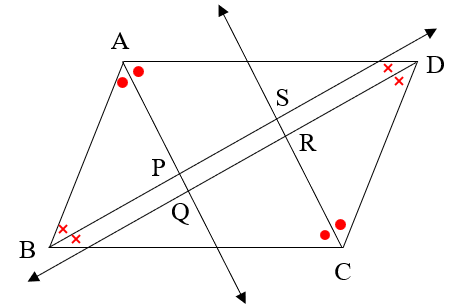
Given:
\(\Box\)ABCD is a parallelogram.
in which AD > AB
The bisectors of its angles meet in points P, Q, R and S as shown.
To prove:
\(\Box\)PQRS is a rectangle.
Proof:
\(\Box\)ABCD is a parallelogram. ... (Given)
∴ AD | | BC ... (Opposite sides of
a | |m)
∴ m\(\angle\)DAB + m\(\angle\)ABC =
180°
... (Converse of Interior Angles Test)
∴ \(\displaystyle \frac{1}{2} \times m\angle \text{DAB} + \frac{1}{2} \times m\angle \text{ABC} = \frac{1}{2} \times 180^\circ\)
∴ \(\displaystyle m\angle \text{PAB} + m\angle \text{PBA} =
90^\circ\)
... (∵ AP and BP are bisectors) ... (i)
Now, in \(\triangle\)APB,
\(\displaystyle m\angle \text{PAB} + m\angle \text{PBA} + m\angle \text{APB}
= 180^\circ\) ... (Theorem)
∴ \(\displaystyle 90^\circ + m\angle \text{APB} = 180^\circ\)
... [From (i)]
∴ \(\displaystyle m\angle \text{APB} = 180^\circ - 90^\circ\)
∴
\(\displaystyle m\angle \text{APB} = 90^\circ\)
∴ \(\displaystyle m\angle \text{SPQ} =
90^\circ\) ... (Vertically opposite angles) ... (ii)
Similarly, AB | | DC ... (Opposite sides of a | |m)
∴
m\(\angle\)CDA +
m\(\angle\)DAB = 180°
... (Converse of Interior Angles Test)
∴ \(\displaystyle \frac{1}{2} \times m\angle \text{CDA} + \frac{1}{2} \times m\angle \text{DAB} = \frac{1}{2} \times 180^\circ\)
∴ \(\displaystyle m\angle \text{QDA} + m\angle \text{QAD} =
90^\circ\)
... (∵ DQ and AQ are bisectors)
... (iii)
Now, in \(\triangle\)DQA,
\(\displaystyle m\angle \text{QDA} + m\angle \text{QAD} + m\angle \text{DQA}
=
180^\circ\) ... (Theorem)
∴ \(\displaystyle 90^\circ + m\angle \text{DQA} = 180^\circ\) ...
[From
(iii)]
∴ \(\displaystyle m\angle \text{DQA} = 180^\circ - 90^\circ\)
∴ \(\displaystyle
m\angle
\text{DQA} = 90^\circ\)
i.e. \(\displaystyle m\angle \text{PQR} = 90^\circ\) ... (iv)
Also, AD | | BC ... (Opposite sides of a
| |m)
∴ m\(\angle\)BCD + m\(\angle\)CDA =
180°
... (Converse of Interior Angles Test)
∴ \(\displaystyle \frac{1}{2} \times m\angle \text{BCD} + \frac{1}{2} \times m\angle \text{CDA} = \frac{1}{2} \times 180^\circ\)
∴ \(\displaystyle m\angle \text{RCD} + m\angle \text{RDC} =
90^\circ\)
... (∵ CR and DR are bisectors) ... (v)
Now, in \(\triangle\)CRD,
\(\displaystyle m\angle \text{RCD} + m\angle \text{RDC} + m\angle \text{CRD}
=
180^\circ\) ... (Theorem)
∴ \(\displaystyle 90^\circ + m\angle \text{CRD} = 180^\circ\) ...
[From
(v)]
∴ \(\displaystyle m\angle \text{CRD} = 180^\circ - 90^\circ\)
∴ \(\displaystyle
m\angle
\text{CRD} = 90^\circ\)
∴ \(\displaystyle m\angle \text{QRS} = 90^\circ\)
... (Vertically opposite angles) ... (vi)
Similarly, AB | | DC ... (Opposite sides of a | |m)
∴
m\(\angle\)ABC +
m\(\angle\)BCD = 180°
... (Converse of Interior Angles Test)
∴ \(\displaystyle \frac{1}{2} \times m\angle \text{ABC} + \frac{1}{2} \times m\angle \text{BCD} = \frac{1}{2} \times 180^\circ\)
∴ \(\displaystyle m\angle \text{SBC} + m\angle \text{SCB} =
90^\circ\)
... (∵ BS and CS are bisectors)
... (vii)
Now, in \(\triangle\)BSC,
\(\displaystyle m\angle \text{SBC} + m\angle \text{SCB} + m\angle \text{BSC}
=
180^\circ\) ... (Theorem)
∴ \(\displaystyle 90^\circ + m\angle \text{BSC} = 180^\circ\) ...
[From
(vii)]
∴ \(\displaystyle m\angle \text{BSC} = 180^\circ - 90^\circ\)
∴ \(\displaystyle
m\angle
\text{BSC} = 90^\circ\)
i.e. \(\displaystyle m\angle \text{RSP} = 90^\circ\) ... (viii)
From (ii), (iv), (vi) and (viii):
\(\Box\)PQRS is a rectangle
∴ The bisectors of the four angles of a parallelogram, which is not a rhombus form a rectangle.
5. In figure 5.25, if points P, Q, R, S are on the sides of parallelogram such that AP = BQ = CR = DS, then prove that \(\Box\)PQRS is a parallelogram.
Proof:
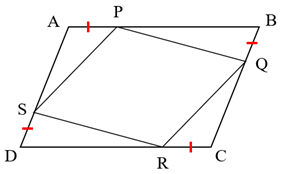
AB = CD ... (Opposite sides of a | |m)
∴ AP + PB = CR + RD
But, AP = CR ... (Given)
∴ PB = RD ... (i)
... (Subtracting AP from LHS and CR from RHS)
Also, BC = DA ... (Opposite sides of a | |m)
∴ BQ + QC = DS + SA
But, BQ = DS
... (Given)
∴ QC = SA ... (ii)
... (Subtracting BQ from LHS and DS from
RHS)
Now, in \(\triangle\)PBQ and \(\triangle\)RDS,
seg PB \(\cong\) seg RD ... [From (i)]
\(\angle\)PBQ = \(\angle\)RDS ... (Opposite angles of a | |m)
seg BQ \(\cong\) seg DS ... (Given)
∴ \(\triangle\)PBQ \(\cong\) \(\triangle\)RDS ... (S A S test)
∴ seg PQ \(\cong\) seg RS ... (c s c t) ... (iii)
Also, in \(\triangle\)QCR and \(\triangle\)SAP,
seg QC \(\cong\) seg SA
... [From (ii)]
\(\angle\)QCR = \(\angle\)SAP ... (Opposite angles of a |
|m)
seg CR \(\cong\) seg AP ... (Given)
∴ \(\triangle\)QCR \(\cong\) \(\triangle\)SAP
... (S A S test)
∴ seg QR \(\cong\) seg SP ... (c s c t) ... (iv)
From (iii) and (iv):
\(\Box\)PQRS is a parallelogram.
This page was last modified on
19 March 2026 at 14:48