1. Diagonals of a rectangle ABCD intersect at point O. If AC = 8 cm then find the length of BO and if \(\angle\)CAD = 35\(^{\circ}\) then find the measure of \(\angle\)ACB.
Solution:
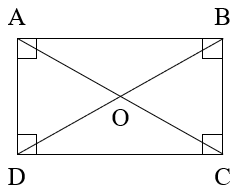
The diagonals of a rectangle are congruent. ... (Theorem)
∴ BD = AC
But, AC = 8 cm ... (Given)
∴ BD = 8 cm ... (i)
Now, the diagonals of a rectangle bisect each other. ... (Theorem)
∴ BO = \(\displaystyle \frac{1}{2}\) × BD
∴ BO = \(\displaystyle \frac{1}{2}\) × 8 ... [From (i)]
∴ BO = 4 cm ... (ii)
Also, side AD | | side BC ... (Opposite sides of a rectangle)
Consider transversal AC
∴ \(\angle\)ACB \(\cong\) \(\angle\)CAD ... (Alternate angles)
But, \(\angle\)CAD = 35° ... (Given)
∴ \(\angle\)ACB = 35° ... (iii)
2. In a rhombus PQRS, if PQ = 7.5 cm, then find QR. If \(\angle\)QPS = 75\(^{\circ}\) then find the measure of \(\angle\)PQR and \(\angle\)SRQ.
Solution:
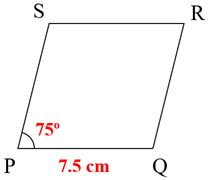
All sides of a rhombus are equal. ... (Definition of a rhombus)
∴ QR = PQ
But, PQ = 7.5 cm ... (Given)
∴ QR = 7.5 cm ... (i)
Now, side PS | | side QR ... (Opposite sides of a rhombus)
Consider transversal PQ
\(\angle\)QPS + \(\angle\)PQR = 180 ... (Interior angles on the same side of the transversal)
∴ 75° +\(\angle\)PQR = 180°
∴ \(\angle\)PQR = 180° − 75°
∴ \(\angle\)PQR = 105° ... (ii)
And \(\angle\)SRQ = \(\angle\)QPS ... (Opposite angles of a rhombus)
But, \(\angle\)QPS = 75° ... (Given)
∴ \(\angle\)SRQ = 75° ... (iii)
3. Diagonals of a square IJKL intersects at point M, Find the measures of \(\angle\)IMJ, \(\angle\)JIK and \(\angle\)LJK .
Solution:
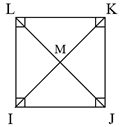
Diagonals of a square bisect each other at right angles. ... (Theorem)
∴ \(\angle\)IMJ = 90° ... (i)
Also, Diagonals of a square bisect opposite angles. ... (Theorem)
∴ \(\angle\)JIK = \(\angle\)LIK = 45° ... (ii)
Similarly, \(\angle\)JIK = \(\angle\)LJK = 45° ... (iii)
4. Diagonals of a rhombus are 20 cm and 21 cm respectively. Then find the side of the rhombus and its perimeter.
Solution:
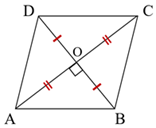
Let, ABCD be that rhombus.
Let, AC = 21 cm and BD = 20 cm
Let, O be the point of intersection of the diagonals.
Now, the diagonals of a rhombus are perpendicular bisectors of each other. ... (Theorem)
∴ AO = \(\displaystyle\frac{\text{AC}}{2}\) = \(\displaystyle\frac{21}{2} = 10.5\) cm ... (i)
And BO = \(\displaystyle\frac{\text{BD}}{2}\) = \(\displaystyle\frac{20}{2} = 10\) cm ... (ii)
Also, \(\angle\)AOB = 90° ... (iii)
Now, in right angled \(\triangle\)AOB,
AB² = AO² + BO² ... (Pythagors’ Theorem)
∴ AB² = (10.5)² + (10)²
∴ AB² = 110.25 + 100
∴ AB² = 210.25
∴ AB = \(\sqrt{210.25}\)
∴ AB = 14.5 cm
∴ Side of that rhombus = 14.5 cm ... (iv)
and the perimeter of that rhombus = 4 × side = 4 × 14.5 = 58 cm ... (v)
5. State with reasons whether the following statements are true or false:
(i) Every parallelogram is a rhombus.
False
A quadrilateral whose all sides are equal is called a rhombus. Every parallelogram may not have all sides equal. Hence, every parallelogram is not a rhombus.
5. State with reasons whether the following statements are true or false:
(ii) Every rhombus is a rectangle.
False
A quadrilateral having each angle equal to 90° (a right angle) is called a rectangle. In every rhombus, all angles may not be right angles. Hence, every rhombus is not a rectangle.
5. State with reasons whether the following statements are true or false:
(iii) Every rectangle is a parallelogram.
True
A quadrilateral having both pairs of opposite sides parallel is called a parallelogram. In a rectangle, both pairs of opposite sides are parallel. Hence, every rectangle is a parallelogram.
5. State with reasons whether the following statements are true or false:
(iv) Every square is a rectangle.
True
A quadrilateral having each angle equal to 90° (a right angle) is called a rectangle. In a square, each angle is equal to 90° (a right angle). Hence, every square is a rectangle.
5. State with reasons whether the following statements are true or false:
(v) Every square is a rhombus.
True
A quadrilateral whose all sides are equal is called a rhombus. In a square, all sides are equal. Hence, every square is a rhombus.
5. State with reasons whether the following statements are true or false:
(vi) Every parallelogram is a rectangle.
False
A quadrilateral having each angle equal to 90° (a right angle) is called a rectangle. Every parallelogram may not have all angles equal to 90°.
This page was last modified on
21 March 2026 at 18:17