1. In figure 5.38, points X, Y, Z are the midpoints of side AB, side BC and side AC of \(\triangle\)ABC respectively. AB = 5 cm, AC = 9 cm and BC = 11 cm. Find the length of XY, YZ, XZ.
Solution:
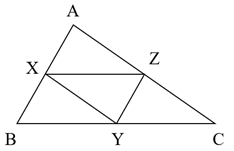
In \(\triangle\)ABC, X and Y are the midpoints of sides AB and BC respectively. ... (Given)
∴ \(\displaystyle \text{XY} = \frac{1}{2}\times \text{AC}\)
... (Theorem of mid-points of two sides of a triangle)
∴ \(\displaystyle \text{XY} = \frac{1}{2}\times 9\)
∴ \(\displaystyle \text{XY} = 4.5 \text{ cm}\) ... (i)
Also, Y and Z are the midpoints of sides BC and AC respectively. ... (Given)
∴ \(\displaystyle \text{YZ} = \frac{1}{2}\times \text{AB}\)
... (Theorem of mid-points of two sides of a triangle)
∴ \(\displaystyle \text{YZ} = \frac{1}{2}\times 5\)
∴ \(\displaystyle \text{YZ} = 2.5 \text{ cm}\) ... (ii)
And, X and Z are the midpoints of sides AB and AC respectively. ... (Given)
∴ \(\displaystyle \text{XZ} = \frac{1}{2}\times \text{BC}\)
... (Theorem of mid-points of two sides of a triangle)
∴ \(\displaystyle \text{XZ} = \frac{1}{2}\times 11\)
∴ \(\displaystyle \text{XZ} = 5.5 \text{ cm}\) ... (iii)
2. In figure 5.39, \(\Box\)PQRS and \(\Box\)MNRL are rectangles. If point M is the midpoint of side PR, then prove that:
(i) SL = LR
(ii) \(\displaystyle \text{LN} = \frac{1}{2}\text{SQ}\)
Proof:
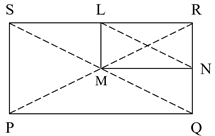
\(\Box\)MNRL is a rectangle. ... (Given)
∴ LM | | RN ... (Opposite sides of a rectangle)
i.e. LM | | RQ ... (∵ R – N – Q) ... (i)
But, RQ | |SP ... (Opposite sides of a rectangle) ... (ii)
From (i) and (ii), we have
LM | | SP ... (iii)
Now, in \(\triangle\)RSP,
M is the midpoint of side PR. ... (Given)
and LM | | SP ... [From (iii)]
∴ L is the midpoint of side SR. ... (Converse of mid-point theorem)
∴ SL = LR ... (iv)
Also, the diagonals of a rectangle are congruent. ... (Theorem)
∴ SQ = PR ... (v)
and LN = MR ... (vi)
But, M is the midpoint of seg PR. ... (Given)
∴ MR = \(\displaystyle \frac{1}{2}\)PR ... (vii)
From (vi) and (vii), we have
∴ LN = \(\displaystyle \frac{1}{2}\)PR ... (viii)
From (v) and (viii), we have
∴ LN = \(\displaystyle \frac{1}{2}\)SQ ... (ix)
3. In figure 5.40, \(\triangle\)ABC is an equilateral triangle. Points F, D and E are midpoints of side AB, side BC, side AC respectively. Show that \(\triangle\)FED is an equilateral triangle.
Proof:
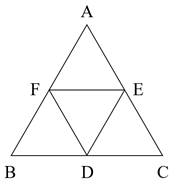
In \(\triangle\)ABC, F and E are midpoints of side AB and side AC respectively. ... (Given)
∴ \(\displaystyle \text{FE} = \frac{1}{2}\text{BC}\) ... (Midpoint Theorem) ... (i)
Also, in \(\triangle\)ABC, D and E are midpoints of side BC and side AC respectively. ... (Given)
∴ \(\displaystyle \text{DE} = \frac{1}{2}\text{AB}\) ... (Midpoint Theorem) ... (ii)
And, in \(\triangle\)ABC, D and F are midpoints of side BC and side AB respectively. ... (Given)
∴ \(\displaystyle \text{DF} = \frac{1}{2}\text{AC}\) ... (Midpoint Theorem) ... (iii)
But, ABC is an equilateral triangle. ... (Given)
∴ \(\displaystyle \text{BC} = \text{AB} = \text{AC}\) ... (Sides of an equilateral triangle)
Multiplying each term by \(\displaystyle \frac{1}{2}\):
\(\displaystyle \frac{1}{2}\text{BC} = \frac{1}{2}\text{AB} = \frac{1}{2}\text{AC}\)
∴ \(\displaystyle \text{FE} = \text{DE} = \text{DF}\) ... [From (i), (ii), (iii)]
∴ \(\triangle\)FED is an equilateral triangle.
4. In figure 5.41, seg PD is a median of \(\triangle\)PQR. Point T is the mid point of seg PD. Produced QT intersects PR at M. Show that:
\(\displaystyle \frac{\text{PM}}{\text{PR}} = \frac {1}{3}\)
[Hint: Draw DN | | QM]
Proof:
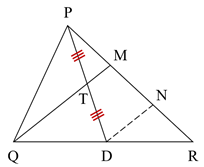
Draw DN | | QM such that P – M – N.
In \(\triangle\)PDN,
T is the mid point of side PD. ... (Given)
and TM | | DN ... (Construction)
∴ M is the mid point of seg PN. ... (Converse of Midpoint Theorem)
∴ PM = MN ... (i)
Also, in \(\triangle\)QRM,
D is the mid point of side QR. ... (Given)
and DN | | QM ... (Construction)
∴ N is the mid point of seg MR. ... (Converse of Midpoint Theorem)
∴ MN = NR ... (ii)
From (i) and (ii):
PM = MN = NR ... (iii)
∴ PR = PM + PM + PM ... [From (iii)]
∴ PR = 3PM
∴ \(\displaystyle \frac{\text{PR}}{\text{PM}} = \frac{3}{1}\)
By Invertendo,
\(\displaystyle \frac{\text{PM}}{\text{PR}} = \frac{1}{3}\)
This page was last modified on
21 March 2026 at 18:13