- Choose correct alternative answer and fill in the blanks:
Click on the question to view the answer
Click on the question to view the answer
The correct option is: (D) rhombus
Solution:
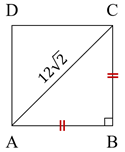
In right \(\triangle\)ABC,
AC² = AB² + BC² ... (Pythgoras’ Theorem)
∴ \(\displaystyle (12\sqrt{2})^2\) = AB² + BC²
∴ 144 × 2 = AB² + AB²
∴ 288 = 2AB²
∴ \(\displaystyle \frac{288}{2}\) = AB²
∴ 144 = AB²
i.e. AB² = 144
∴ AB = \(\sqrt{144}\)
∴ AB = 12 cm ... (i)
Now, Perimeter of a square = 4 × side
∴ Perimeter = 4 × 12
∴ Perimeter = 48 cm
∴ The correct option is: (C) 48 cm
Solution:
The opposite angles of a rhombus are congruent.
∴ 2x = 3x − 40
∴ 2x − 3x = − 40
∴ − x = − 40
i.e. x = 40
The correct option is: (D) 40\(^{\circ}\)
2. Adjacent sides of a rectangle are 7 cm and 24 cm. Find the length of its diagonal.
Solution:
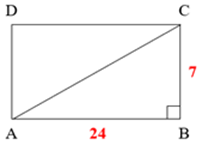
In right \(\triangle\)ABC,
AC2 = AB2 + BC2 ... (Pythagoras’ Theorem)
∴ AC2 = 242 + 72
∴ AC2 = 576 + 49
∴ AC2 = 625
∴ AC = \(\sqrt{625}\)
∴ AC = 25 cm
∴ The length of the diagonal is 25 cm.
3. If the diagonal of a square is 13 cm then find its side.
Solution:
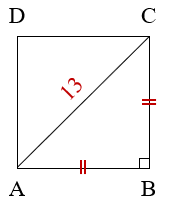
In right \(\triangle\)ABC,
AC² = AB² + BC² ... (Pythgoras’ Theorem)
∴ 13² = AB² + BC²
∴ 169 = AB² + AB²
∴ 169 = 2AB²
∴ \(\displaystyle \frac{169}{2}\) = AB²
i.e. AB² = \(\displaystyle \frac{169}{2}\)
∴ AB = \(\displaystyle \sqrt{\frac{169}{2}}\)
∴ AB = \(\displaystyle \frac{\sqrt{169}}{\sqrt{2}}\)
∴ AB = \(\displaystyle \frac{13}{\sqrt{2}}\)
Rationalizing the denominator:
∴ AB = \(\displaystyle \frac{13}{\sqrt{2}} \times \frac{\sqrt{2}}{\sqrt{2}}\)
∴ AB = \(\displaystyle \frac{13\sqrt{2}}{2}\)
∴ AB = \(\displaystyle 6.5\sqrt{2}\) cm ... (i)
∴ The side of the square is \(\displaystyle 6.5\sqrt{2}\) cm
4. Ratio of two adjacent sides of a parallelogram is 3 ∶ 4, and its perimeter is 112 cm. Find the length of its each side.
Solution:
Let the two adjacent sides of the parallelogram be 3x cm and 4x cm respectively.
From the given information,
∴ 3x + 4x + 3x + 4x = 112
∴ 14x = 112
∴ \(\displaystyle x = \frac{112}{14}\)
∴ \(\displaystyle x = 8\) cm ... (i)
∴ 3x = 3 × 8 = 24 cm
and 4x = 4 × 8 = 32 cm
∴ The lengths of the sides of that parallelogram are 24 cm, 32 cm, 24 cm and 32 cm respectively.
5. Diagonals PR and QS of a rhombus PQRS are 20 cm and 48 cm respectively. Find the length of side PQ.
Solution:
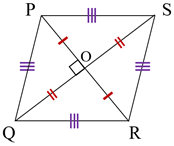
Let \(\Box\)PQRS be the given rhombus.
Let PR = 20 cm and QS = 48 cm.
The diagonals of a rhombus are perpendicular bisectors of each other. ... (Theorem)
∴ \(\angle\) POQ = 90\(^\circ\)
Also, PO = \(\displaystyle \frac{1}{2}\) PR
∴ PO = \(\displaystyle \frac{1}{2} \times 20\)
∴ PO = 10 cm ... (i)
And, QO = \(\displaystyle \frac{1}{2}\) QS
∴ QO = \(\displaystyle \frac{1}{2} \times 48\)
∴ QO = 24 cm ... (ii)
In right \(\triangle\)POQ,
PQ2 = PO2 + QO2 ... (Pythagoras’ Theorem)
∴ PQ2 = 102 + 242
∴ PQ2 = 100 + 576
∴ PQ2 = 676
∴ PQ = \(\sqrt{676}\)
∴ PQ = 26 cm
∴ The length of side PQ is 26 cm.
6. The diagonals of a rectangle PQRS intersect at M. If \(\angle\)QMR = 50º, find \(\angle\)MPS.
Solution:
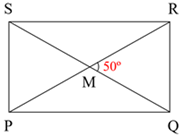
Let \(\Box\)PQRS be the given rectangle.
Let the diagonals PR and QS intersect at M.
Now, \(\angle\)SMP \(\cong\) \(\angle\)QMR ... (Vertically opposite angles)
But, \(\angle\)QMR = 50\(^{\circ}\) ... (Given)
∴ \(\angle\)SMP = 50\(^{\circ}\) ... (i)
Also, the diagonals of a rectangle are congruent and bisectors of each other. ... (Theorem)
∴ SQ = RP
∴ \(\frac {1}{2}\)SQ = \(\frac {1}{2}\)RP
∴ MS = MP
∴ In \(\triangle\)SMP,
\(\angle\)MSP = \(\angle\)MPS ... (Theorem of isosceles triangle) ... (ii)
And, in \(\triangle\)SMP,
\(\angle\)MPS + \(\angle\)MSP + \(\angle\)SMP = 180\(^{\circ}\) ... (Theorem)
∴ \(\angle\)MPS + \(\angle\)MPS + 50\(^{\circ}\) = 180\(^{\circ}\) ... [From (ii)]
∴ 2\(\angle\)MPS + 50\(^{\circ}\) = 180\(^{\circ}\) − 50\(^{\circ}\)
∴ 2\(\angle\)MPS = 130\(^{\circ}\)
∴ \(\angle\)MPS = \(\displaystyle \frac{130^{\circ}}{2}\)
∴ \(\angle\)MPS = 65\(^{\circ}\)
7. In the adjacent Figure 5.42,
if seg AB | | seg PQ , seg AB \(\cong\) seg PQ,
seg AC | | seg PR, seg AC \(\cong\) seg PR
then prove that,
seg BC | | seg QR and seg BC \(\cong\) seg QR.
Proof:
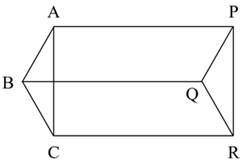
In \(\Box\)ABQP,
seg AB | | seg PQ ... (Given) and
seg AB \(\cong\) seg PQ ... (Given)
∴, \(\Box\)ABQP is a parallelogram. ... (Theorem)
∴ seg AP | | seg BQ ... (i)
... (Opposite sides of a | |m).
and seg AP \(\cong\) seg BQ ... (ii)
... (Opposite sides of a | |m)
Also, in \(\Box\)ACRP,
seg AC | | seg PR ... (Given) and
seg AC \(\cong\) seg PR ... (Given)
∴, \(\Box\)ACRP is a parallelogram. ... (Theorem)
∴ seg AP | | seg CR ... (iii)
... (Opposite sides of a | |m).
and seg AP \(\cong\) seg CR ... (iv)
... (Opposite sides of a | |m)
And, in \(\Box\)BQRC,
seg BQ | | seg CR ... [From (i) and (iii)] and
seg BQ \(\cong\) seg CR ... [From (ii) and (iv)]
∴, \(\Box\)BQRC is a parallelogram. ... (Theorem)
∴ seg BC | | seg QR ... (v)
... (Opposite sides of a | |m).
and seg BC \(\cong\) seg QR ... (vi)
... (Opposite sides of a | |m)
8. In fig. 5.43, \(\Box\)ABCD is a trapezium. AB | | DC. Points P and Q are the midpoints of seg AD and seg BC respectively. Then prove that:
PQ | | AB and
\(\displaystyle \text{PQ} = \frac{1}{2} \text{(AB + DC)}\)
Construction:
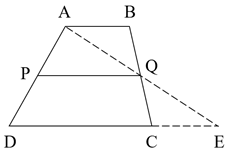
Draw seg AQ. Extend segments DC and AQ such that they meet in point E.
Proof:
In \(\triangle\)ABQ and \(\triangle\)ECQ,
\(\angle\)AQB \(\cong\) \(\angle\)EQC ... (Vertically opposite angles)
seg BQ \(\cong\) seg CQ ... (Given)
\(\angle\)ABQ \(\cong\) \(\angle\)ECQ ... (Alternate angles)
∴ \(\triangle\)ABQ \(\cong\) \(\triangle\)ECQ ... (A S A test)
∴ seg AB \(\cong\) seg EC ... (c s c t) ... (i)
and seg AQ \(\cong\) seg EQ ... (c s c t)
∴ Q is the midpoint of seg AE.
But, P is the midpoint of seg AD. ... (Given)
∴ In \(\triangle\)ADE,
PQ | | DE ... (Midpoint theorem)
i.e. PQ | | DC ... (∵ D – C – E)
But, DC | | AB ... (Given)
∴ PQ | | AB ... (ii)
Also, in \(\triangle\)ADE, P is the midpoint of seg AD and Q is the midpoint of seg AE.
∴ \(\displaystyle \text{PQ} = \frac{1}{2} \text{DE}\) ... (Midpoint theorem)
∴ \(\displaystyle \text{PQ} = \frac{1}{2} \text{(DC + CE)}\) ... (∵ D – C – E)
But, CE = AB ... [From (i)]
∴ \(\displaystyle \text{PQ} = \frac{1}{2} \text{(DC + AB)}\)
i.e. \(\displaystyle \text{PQ} = \frac{1}{2} \text{(AB + DC)}\)
9. In the adjacent figure 5.44, \(\Box\)ABCD is a trapezium. AB | | DC. Points M and N are the midpoints of diagonal AC and DB respectively,
then prove that: MN | | AB.
Construction:
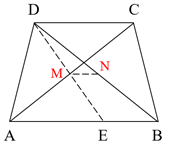
Draw seg MN. Draw seg DM and extend it to meet side AB in point E.
Proof:
In \(\triangle\)DMC and \(\triangle\)EMA,
seg CM \(\cong\) seg AM ... (Given)
\(\angle\)CDM \(\cong\) \(\angle\)AEM ... (Alternate angles)
\(\angle\)CMD \(\cong\) \(\angle\)AME ... (Vertically opposite angles)
∴ \(\triangle\)DMC \(\cong\) \(\triangle\)EMA ... (S A A test)
∴ seg DM \(\cong\) seg EM ... (c s c t)
∴ M is the mid-point of seg DE. ... (i)
Now, in \(\triangle\)DEB,
M and N are the midpoints of seg DE and seg DB respectively.
... [From (i) and Given]
∴ MN | | EB ... (Midpoint theorem)
i.e. MN | | AB ... (∵ A – E – B)
This page was last modified on
22 March 2026 at 18:34